
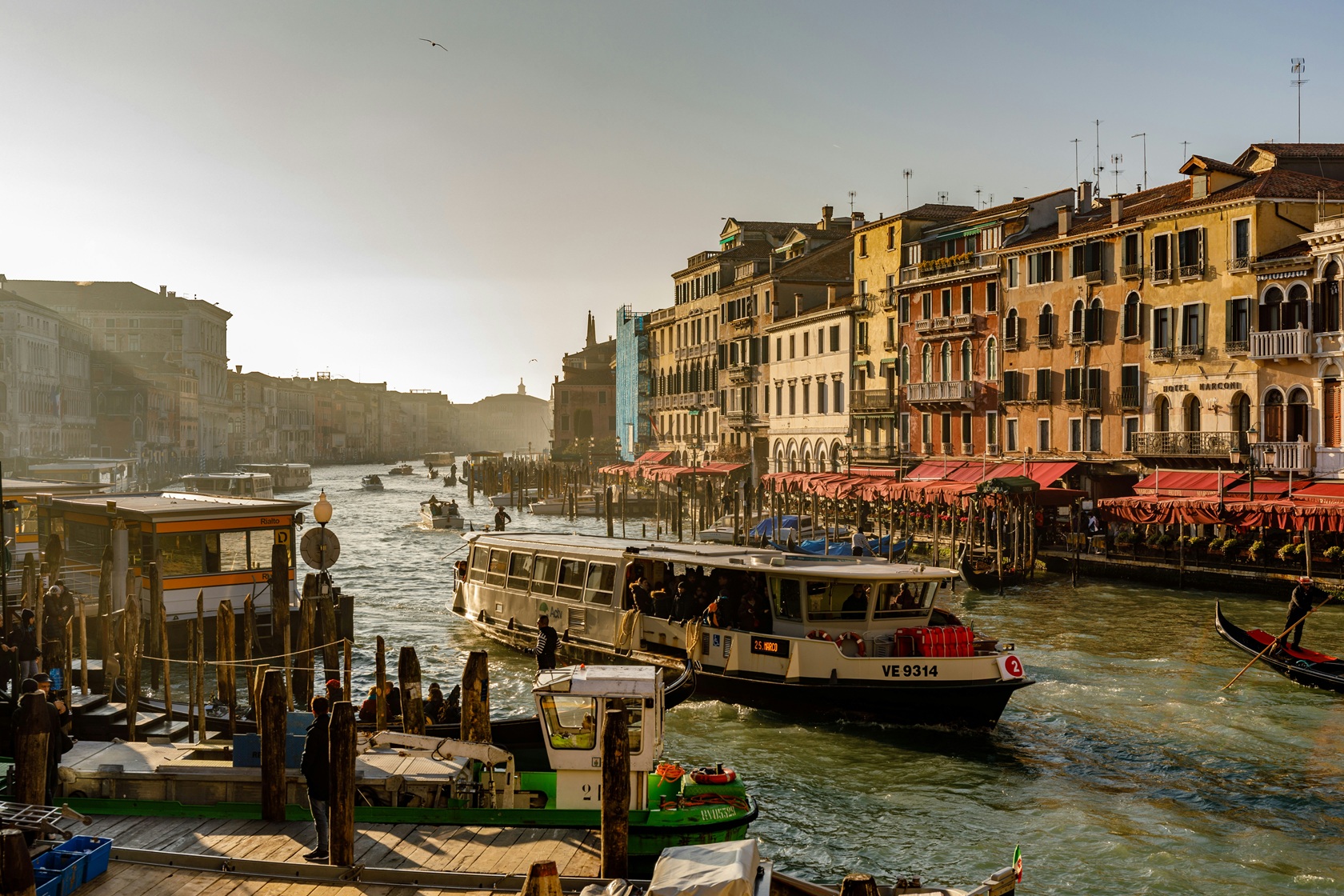
Venice is unlike almost any other city in the world. Instead of relying on cars, buses, and an underground metro, visitors get around on foot and by boat. Narrow pedestrian lanes wind between historic buildings, bridges cross hundreds of small canals, and boats provide public transportation along the Grand Canal and out to the islands of the Venetian Lagoon.
For first-time visitors, the challenge is learning which mode of transportation to use, how to find the right stop, how to pay, and when a boat ride is worth the expense. The good news is that Venice becomes much easier to navigate once you understand four basic options: walking, the vaporetto, the traghetto, the private water taxi, and the people mover.
This guide explains how each works, what to expect, and how to avoid common transportation mistakes. Fares and payment systems can change, so the official links provided below are the best places to confirm current prices before your trip.
1. Walking: the best way to discover Venice


Walking is the best way to explore Venice’s historic center. Many of the city’s most memorable discoveries are found along narrow lanes called calli, in small squares called campi or campielli, and beside canals too small for public boats.
Venice is compact enough to explore much of the historic center on foot, but distances can be deceptive. A hotel that looks close to a landmark on a map may be separated from it by canals, bridges, and winding streets. Your route may also take you away from the direct line shown on a map.
- Straight-Across Distance: About 4 kilometers (2.5 miles).
- Active Walking Time: 45 to 60 minutes if you walk continuously without stopping or getting lost.
- Realistic Time with Crowds & Bridges: Allow 2 to 3 hours in practice. Navigating narrow winding alleys, waiting on pedestrian crowds, getting lost, stopping for phots, and navigationg across canal bridges will slow down your pace.
- Shorter Crossings: Walking between major central landmarks like the Rialto Bridge and St. Mark’s Square takes only about 15 to 20 minutes.
Understanding Venice’s bridges
One important detail catches many first-time visitors by surprise: only four bridges cross the Grand Canal itself. They are:
-
Ponte della Costituzione: connects the Piazzale Roma transportation terminal with the area near Santa Lucia railway station.
-
Ponte degli Scalzi: crosses the Grand Canal beside the railway station.
-
Rialto Bridge: the famous stone bridge near the historic Rialto Market.
-
Ponte dell’Accademia: connects the San Marco side of the canal with the Dorsoduro district.
Note: “Ponte” means “Bridge” in Italian
These bridges are not evenly distributed along the canal. If your destination is on the opposite bank, you may need to walk quite a distance to reach the nearest crossing and then double back.
There are, of course, many more bridges over Venice’s smaller canals. They make walking possible throughout the city, but the steps can be difficult for visitors with mobility limitations or heavy luggage.
How to navigate on foot

Look up at the yellow directional signs mounted on buildings. These commonly point toward major destinations such as San Marco, Rialto, Ferrovia (the railway station), and Piazzale Roma (the bus and vehicle terminal).
A few practical tips:
- Use a map app, but check the actual walking route rather than relying on the straight-line distance.
- Allow extra time for bridges, crowds, and wrong turns.
- Follow signs toward a major landmark when you become disoriented; you can usually find your bearings again.
- Keep to the right on pedestrian routes and avoid stopping in the middle of bridges, particularly busy ones.
- If you have a suitcase, check whether your hotel can be reached conveniently from a vaporetto stop. A short distance on the map can involve numerous bridges.
Venice’s lanes are part of the experience, so don’t be afraid to wander. Just keep track of your location if you have a timed reservation or need to catch a boat.
2. The vaporetto: Venice’s public water bus

The vaporetto (plural: vaporetti) is Venice’s public water bus. It is operated by ACTV and is the most practical way to travel longer distances through the historic center, along the Grand Canal, and to islands such as Murano, Burano, and the Lido.
Unlike a private water taxi, a vaporetto follows scheduled routes and stops at designated floating platforms. Think of it as a city bus that travels on water.
How to find vaporetto stops
Look for floating landing platforms, often called pontili, with signs showing the stop name and the routes that serve it. Some stops have enclosed waiting areas; others are relatively simple platforms.
The most useful sources for identifying stops and planning journeys are:
- ACTV’s official waterborne transport information
- Venezia Unica’s public transport guide
- Venezia Unica’s official transport route planner
Before boarding, check the line number, destination, and direction of travel. A stop may serve several lines, and a boat passing your platform is not necessarily going where you want to go.
What do the different colors mean?
You may see colored lines on transit maps and colored route markings in journey-planning information. These help distinguish routes from one another, but you should not rely on color alone to choose a boat.

The line number and the destination displayed on the boat and at the landing are the important identifiers. Check these against the current ACTV map or timetable. Route patterns and operating hours can differ, and not every line stops at every landing.
Also, don’t confuse the ACTV vaporetto with Alilaguna, a separate scheduled boat service that connects Marco Polo Airport with Venice and various lagoon destinations. The two services have different routes and ticket arrangements.
Which vaporetto line should you take?
Line 1 — for the Grand Canal experience
Line 1 makes frequent stops along the Grand Canal, making it a good choice when you want to enjoy the historic palaces and waterfront scenery. It is slower than a service that skips stops, but that is part of its appeal.
Line 2 — for a faster journey on served sections
Line 2 serves fewer stops on parts of the central network. It can be useful when its route and operating hours match your destination, but don’t assume it follows exactly the same stopping pattern as Line 1.
Island routes — for Murano, Burano, and the Lido
Other ACTV lines connect Venice with the islands and other lagoon destinations. Check the official route map for the correct line and any transfers needed for your particular journey.
These are planning suggestions, not a substitute for checking the timetable on your travel date. Routes and schedules can change seasonally.
How much does the vaporetto cost?
The official published ACTV tourist fares currently include the following options:
| Ticket or pass | Price |
|---|---|
| Standard 75-minute ticket | €9.50 |
| 24-hour pass | €25 |
| 48-hour pass | €35 |
| 72-hour pass | €45 |
| 7-day pass | €65 |
Prices checked against the official Venezia Unica ticket information in October 2026. Confirm current terms before travel.
The standard ticket covers eligible ACTV urban waterborne services and specified land transport within its validity rules. It is not a ticket for every boat service in Venice, and separate fares apply to services such as Alilaguna airport boats.
A 75-minute ticket can be useful for a single journey or a short series of eligible connections. If you expect to use the vaporetto repeatedly, compare the total cost of individual fares with a time-limited pass.
Official ticket information and purchases: Venezia Unica — Public Transport Tickets
Paying for the vaporetto: contactless cards versus tickets
Venice’s public transport system supports contactless payments, making it possible to pay with an eligible credit or debit card, or a supported digital wallet on a phone or smartwatch, without buying a paper ticket first.
You generally have two main options.
Option A: Tap a contactless bank card or device
- At the boarding platform, locate the contactless validator.
- Tap your card or device against the reader and wait for the confirmation signal.
- Board the correct boat.
- If you are inspected, present the same card or device you used to pay.
ACTV’s contactless system includes a best fare mechanism that can calculate an eligible fare based on your journeys. For example, its published example shows that three journeys within 24 hours can qualify for the €25 daily-pass price instead of three separate €9.50 fares.
A few important rules:
- Use the same physical card or the same digital device consistently for each journey. Tapping a physical card and then switching to the phone’s digital version of that card may be treated as using different payment credentials.
- On waterborne services, ACTV says a tap-out is not required. Rules differ on some land services, where tapping out may be necessary.
- Each traveler should use an appropriate individual payment credential or ticket. Don’t assume that one tap pays for everyone in your party.
- The bank or card issuer may impose its own foreign-transaction fees.
Option B: Buy a ticket or pass in advance
You can buy eligible tickets online through Venezia Unica, through the official transport app, from ticket offices, at self-service machines, and from authorized sellers.
If you use a ticket or electronic travel card, follow the instructions for validating it before boarding. Buying a ticket is not always the same as activating it.
Which is better? Contactless payment is convenient for visitors who want to avoid a separate ticket purchase. A prepaid pass can be easier if you want to organize your transport budget in advance or prefer not to use a bank card for every journey. Compare the available fares and conditions before choosing.
Official guidance: ACTV — EMV Contactless Payments and How to use the validator
3. The traghetto: an inexpensive gondola crossing

A traghetto (plural: traghetti) is a traditional gondola ferry that carries passengers across the Grand Canal between two banks. It is different from the gondola ride most visitors book for sightseeing: a traghetto is primarily a practical means of crossing the canal.
Remember those four bridges? If you’re walking through Venice and need to cross the Grand Canal somewhere between them, a traghetto may save you a substantial detour.
Where do you find a traghetto?
Look for a designated ferry landing, often marked by a sign identifying the traghetto or servizio traghetto. These are not the same as the floating ACTV vaporetto platforms.
The municipality publishes information about the public ferry crossings, including their locations, operating hours, and fares. The official list has included these locations:
- Santa Sofia: near the Rialto Market area, connecting the Cannaregio side with the San Polo side.
- Riva del Carbon: near the Rialto Bridge.
- San Tomà: connecting the San Polo and Dorsoduro sides.
- Santa Maria del Giglio: useful when crossing between the San Marco and Dorsoduro sides.
- Punta della Dogana (Dogana): near the entrance to the Grand Canal and the Salute area.
Not every listed crossing necessarily operates every day. Some services have been suspended or have limited hours, so check the municipal information and look for signs at the landing when you arrive.
Official source: Municipality of Venice — Traghetto Fares, Hours, and Locations.
How much does a traghetto cost?
The municipality’s published tariff lists:
| Passenger | Published fare |
|---|---|
| Resident or eligible Venezia Unica cardholder | €0.70 |
| Other passengers, including tourists | €2.00 |
These are the published municipal fares, but operating conditions and tariffs can change. Confirm the amount at the landing before boarding.
A traghetto is an excellent way to experience a gondola without paying for a full sightseeing ride. The crossing is brief, generally lasting only a few minutes.
How to use and pay for a traghetto
- Find the designated landing. Check the municipal list or your map, and confirm that the service is operating.
- Ask the attendant about payment. Follow the instructions at the landing, and have small euro notes or coins available. Do not assume that the ACTV contactless system applies to the traghetto.
- Board when directed. These boats are working ferries, not private sightseeing gondolas. Follow the crew’s instructions about where to stand or sit.
- Cross to the opposite bank. The journey is short. Disembark when directed and continue on foot.
One final tip: don’t confuse a traghetto with a conventional gondola tour. If you want a leisurely ride through smaller canals, a gondola tour is the appropriate choice. If you simply need to get across the Grand Canal, the traghetto is often the better option.
4. Water taxis: convenient, comfortable, and expensive

A private water taxi is the closest thing Venice has to a conventional taxi. It is a motorboat that can transport you and your party between designated piers and, where navigable and permitted, smaller canals near your hotel.
Water taxis are particularly useful when:
- You have heavy luggage and want to avoid carrying it over bridges.
- You are traveling with several people and can share the cost.
- You arrive late at night or need a convenient transfer.
- Your hotel has convenient water access.
- You want a direct, private transfer rather than a scheduled public boat.
The main disadvantage is price. Water taxis cost substantially more than the vaporetto, so they are usually best reserved for transfers when convenience matters most.
How much does a water taxi cost?
Water taxi fares depend on the route, destination, time of day, passenger and luggage arrangements, and any applicable supplements.
For planning purposes, current published travel guidance gives the following indicative ranges:
| Journey | Approximate cost |
|---|---|
| Short city transfer | €50–€60 per boat |
| Santa Lucia station or Piazzale Roma to San Marco | Around €50–€60 per boat |
| Marco Polo Airport to central Venice, private boat | Around €110–€180 per boat |
| Shared airport transfer | From approximately €39 per person |
These are indicative planning figures, not guaranteed quotations. Actual prices vary by operator, destination, and booking conditions. Verify the total price before confirming your trip.
For a group, the price per person may be reasonable when several travelers share one boat. For a solo traveler or couple, the vaporetto or another scheduled transfer will usually be less expensive.
How to book a water taxi
The safest approach is to book through an established operator or use an official taxi station.
You canfind official water taxi stands at major transportation points, including Piazzale Roma, Santa Lucia railway station, and other designated locations around Venice. Look for the official taxi signage rather than accepting an unsolicited offer from someone claiming to provide a taxi.
Important: A water taxi cannot necessarily deliver you to the door of every hotel. Some hotels are not directly accessible by boat, and even hotels beside a canal may have a particular designated landing point. Ask your hotel about the nearest water taxi drop-off before booking.
5. Getting to and from Marco Polo Airport

Your airport transfer deserves special consideration because not every boat service operates in the same way. You generally have three useful options for reaching Venice from Marco Polo Airport.
| Option | Best for |
|---|---|
| ACTV or ATVO airport bus to Piazzale Roma | Travelers prioritizing cost and connecting with walking or the vaporetto |
| Alilaguna scheduled airport boat | Travelers whose hotel is convenient to an Alilaguna landing |
| Private water taxi | Travelers prioritizing a direct transfer, privacy, and convenience |
Alilaguna is a separate scheduled service, not an ACTV vaporetto. It has its own lines, tickets, and fares. Likewise, standard ACTV tourist passes should not be assumed to cover your airport transfer.
Before booking, compare the total journey rather than just the initial fare. A cheap bus ticket may leave you with a walk over several bridges, whereas a boat that stops nearer your hotel might save time and effort.
Official information: Venezia Unica — Public Transport
For private transfers between the Airport, Cruise Ports, and Hotels, you can always reach out to the professionals at AARON JOSEPH TRAVEL. You can also use this link. Private Transfers then select the “Private Transfers” tab. In the From and To sections, select whether it is the Airport, Cruise Port, Train Station, or Hotel/Address. To the right enter the approriate information.
6. The People Mover: a quick connection between Piazzale Roma and Tronchetto

Photo: Didier Descouens, via Wikimedia Commons, licensed under CC By-SA 4.0
Venice has one more useful transportation option that first-time visitors may overlook: the People Mover, an automated, elevated shuttle that connects Piazzale Roma, the city’s main bus and vehicle terminal, with Tronchetto, the island used for parking and some cruise-related services. It also stops at the Marittima cruise terminal area. The short journey from Tronchetto to Piazzale Roma takes approximately four minutes.
The People Mover is particularly useful if you park at Tronchetto, arrive by car, or need to connect with transportation at Piazzale Roma. It is not a substitute for the vaporetto network, however, and it does not travel through Venice’s historic center.
Where to find the People Mover
Look for signs for People Mover at Tronchetto or Piazzale Roma. The system has three stations:
- Tronchetto: serves the parking island and nearby transport connections.
- Marittima: serves the cruise terminal area.
- Piazzale Roma: connects with the bus terminal and provides access to the historic center on foot or by vaporetto.
Once you reach Piazzale Roma, you can walk into Venice or transfer to an ACTV water bus at a nearby landing.
How much does the People Mover cost?
The published one-way fare is €1.50 per person. A dedicated People Mover ticket covers one journey in either direction.
Eligible ACTV network tickets and passes are also valid on the People Mover, so you may not need to buy an additional ticket if you already have an appropriate transport pass. Check the conditions of your ticket before boarding.
How to buy and use a ticket
- Buy a dedicated ticket from the automatic ticket machines at the People Mover stations, or through an official AVM sales channel.
- If using a paper or electronic ticket, follow the validation instructions before boarding.
- Follow the station signs to the correct platform and board the shuttle in the direction of your destination.
When does it operate?
The published schedule varies by season and day of the week. The operator lists service generally from 7:00 a.m. on weekdays, with different starting times on holidays and during winter. Confirm the timetable before relying on it for an early departure or late-night connection.
For current information, fares, and schedules, consult the official ACTV People Mover website.
Traveler tip: If you’re arriving in Venice by car, the People Mover can save you a walk from Tronchetto to Piazzale Roma. If you’re already staying in the historic center, you’ll probably find walking and the vaporetto more useful for most of your sightseeing.
7. Essential tips for first-time visitors

Think about luggage before choosing your route
Bridges often have steps, and not every hotel is next to a vaporetto stop. Ask your accommodation which landing is most convenient and whether there is an accessible route.
Allow time for boarding and transfers
Check current timetables, especially for evening travel and island excursions. A route that works during the day may operate differently late at night.
Keep your belongings secure
Busy boat platforms and crowded pedestrian routes require the same care you would take in any major tourist destination. Keep valuables secure and leave room for passengers to board and exit.
Check conditions before setting out
High water, weather, service changes, and temporary closures can affect your plans. Check official notices rather than assuming a route or landing is operating normally.
A final word on choosing the right transport
Venice is best experienced by combining different ways of getting around.
- Walk to explore the lanes, squares, churches, and small canals.
- Take the vaporetto for longer journeys and the views along the Grand Canal.
- Use a traghetto when you need to cross the Grand Canal where there is no convenient bridge.
- Book a water taxi when luggage, convenience, or a direct transfer justifies the higher cost.
- Use the People Mover to travel between Pizzale Roma, the (old) Cruise Terminal – now only used for smaller ships, and Tronchetto
With a little preparation, you can navigate Venice confidently without spending more than necessary on transportation. And remember: in Venice, getting from one place to another can be part of the experience itself.
Official sources and further reading
The following are the primary sources I recommend consulting for current fares, routes, operating hours, and booking information.
1. ACTV — Contactless payment and fares: EMV contactless payments. Explains eligible contactless payment methods, the best-fare system, and applicable ticket prices.
2. Venezia Unica — Public transport: Transport information, routes, and ticket options. Provides access to route maps, timetables, ACTV ticket options, and information about Alilaguna.
3. ACTV — Using validators: How to validate tickets and use contactless payment. Explains validation procedures and the rules for using the same payment credential.
4. Municipality of Venice — Traghetto service: Fares, locations, and operating hours. The municipal source for the published traghetto fares and schedules.
5. Municipality of Venice — Water taxi tariffs: Official tariff information. Provides access to municipal water taxi tariff information.
Editorial note: Public transport and traghetto fares above are based on the official information available in October 2026. Water taxi prices are indicative estimates rather than guaranteed municipal quotations. Check the relevant operator’s current terms before traveling.


